


What’s new in regulatory reporting for 2025-2027?
Every year, European and national authorities update the rules and data formats used for regulatory reporting. For many companies, it can feel overwhelming to follow all changes – but the good news is that most updates are predictable and follow clear timelines.
Below is an overview of the most important changes coming between 2025 and 2027 for Solvency II, Pension Funds, and French national reporting.
This article will help reporting managers understand what’s changing, why it matters, and how UBPartner supports these updates.
National French updates for 2025 (ACPR)
The ACPR introduced several updates to national reporting requirements for insurers and pension funds starting in 2025. These changes mainly affect the additional national templates (ENS) that complement European reports.
The key points:
- Updated retirement-related statistics:
The classification of retirement products has been refreshed so that reports better reflect how these products are actually used on the market today. - Clearer information about real-estate assets:
Companies now need to indicate whether their real-estate holdings are owned directly or managed through investment funds, giving supervisors a more accurate view of how assets are structured. - More complete information for pension products:
Pension and retirement schemes require a bit more detail in reporting to align with the latest supervisory expectations.
What this means:
French entities will see slightly updated templates, but the structure remains similar. UBPartner tools are being continuously updated with the new ACPR instructions so clients can report without disruption.
European taxonomy updates for 2025
In 2025, both Solvency II and Pension Funds reporting are updated to include the new NACE 2.1 economic activity classification, which is used broadly across EU reporting.
Key updates include:
- New optional taxonomy packages released by EIOPA in mid-2025.
- First mandatory use planned for year-end 2025 reports.
What this means:
Companies will simply select the new NACE categories when preparing certain templates. UBPartner solutions include these updated taxonomies so users don’t need to manage files manually.
Looking ahead to 2026–2027
Solvency II 2.10 – a major revision
The European regulator is preparing a major update of the Solvency II taxonomy: version 2.10, which will become mandatory in 2027.
Timetable at a glance:
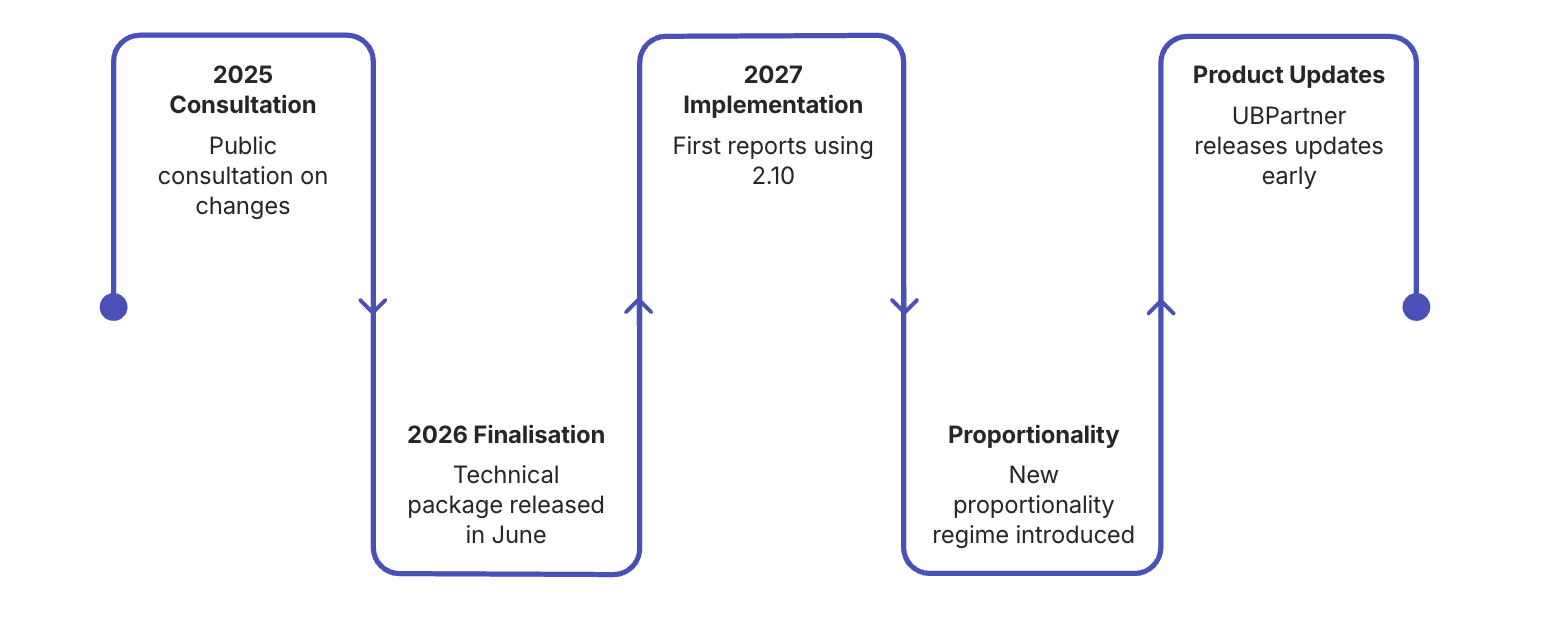
The goal of the revision:
- Reduce administrative burden for insurers
- Adapt reporting rules to recent regulatory changes
- Introduce a new proportionality regime
What this means:
The structure of some templates may change, and reporting frequency for certain items may be reduced. UBPartner will release product updates well ahead of each milestone to ensure a smooth transition.
A new framework for smaller insurers
The revised Solvency II Directive introduces a new category:
Small and non-complex (SNC) entities.
These companies will benefit from:
- Fewer detailed templates
- Lower reporting frequency in some cases
- Simplified content requirements
What this means:
Some insurers will report less data – but still in the same XBRL format. UBPartner tools automatically apply the correct rules depending on the entity’s size and profile.
Continuity for pension funds reporting
Pension funds (IORP/ORPS) will also see updates aligned with the Solvency II changes:
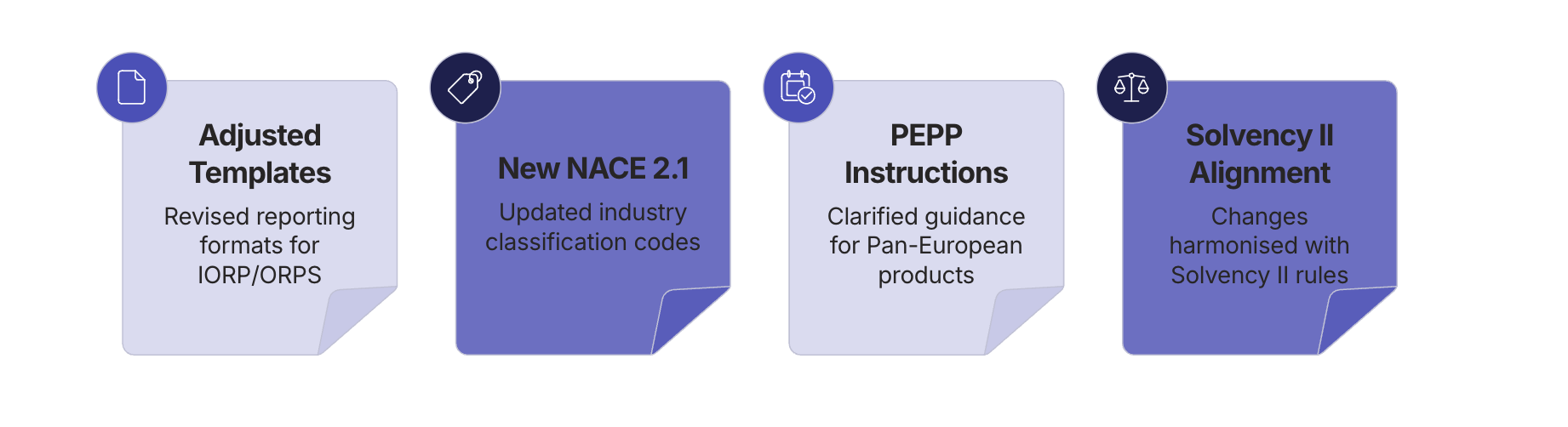
UBPartner continues to support full Pension Funds reporting, including national French requirements.

How UBPartner helps companies stay compliant
Regulatory rules and formats evolve constantly – but our goal is to make these changes as simple as possible for reporting teams.
With UBPartner’s XBRL Toolkit and cloud services, clients benefit from:
✔ Always up-to-date taxonomies
Our team integrates the latest ACPR and EIOPA updates as soon as they are released.
✔ Full validation and error-checking
Ensuring correct reporting before submission.
✔ Support for both European and national submissions
Including Solvency II, Pension Funds, French national templates (ENS), and PEPP.
✔ Clear documentation and client support
Helping teams understand what changed and how to report correctly.

Make the 2025–2027 transitions seamless.
Get in touch with UBPartner for an updated, compliant reporting workflow.